
Curriculum
The curriculum consists of everything that promotes learners’ intellectual, personal, social and physical development. As well as lessons and extracurricular activities, it includes approaches to teaching, learning and assessment, the quality of relationships within school, and the values embodied in them.
Bournemouth School provides a broadly based academic curriculum which gives every student the opportunity to realise their full potential so that they may be in the strongest position possible to pursue careers or continue with the education of their choosing. The curriculum promotes the intellectual, personal, social and physical development of all learners and establishes high expectations for all, extending horizons and raising aspirations.
The school’s provision is regularly reviewed to reflect changes in the needs and aspirations of our students, examination results, the relevant legislative framework and any appropriate educational initiatives.
Advances in cognitive science have shaped our curriculum by highlighting the importance of working-memory limits, spaced retrieval, and structured knowledge building. We have designed curricula that sequence content more deliberately, revisit core ideas, and reduce unnecessary cognitive load. Teaching staff’s efforts have been focused on clear explanations, guided practice, modelling, and frequent checking for understanding. We believe that our evidence-based approach leads students toward independent mastery and improved long-term outcomes.
Any comments about the school’s curriculum should be directed, in the first instance, to the appropriate Director of Learning.
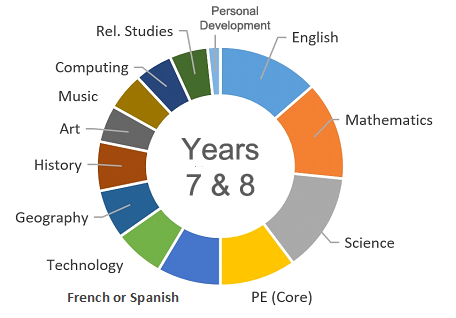
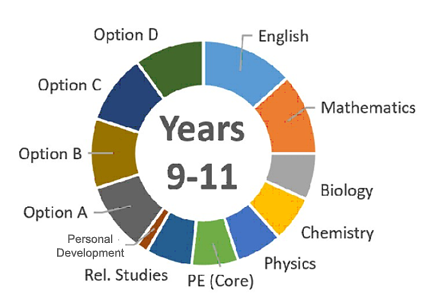
Individual Curriculum Maps
Spiritual, Moral, Social and Cultural Development
Students engage well with the school's PSHCE programme, which deals with relevant issues in each Year group, e.g. keeping healthy, road safety, drugs, alcohol and relationship education.
Students make a very strong contribution, both as leaders and participants, to many activities and events. They lead and perform in assemblies and other presentations where they share and celebrate their experiences. The prefect system is a great strength in this respect; both creating and developing an expectation that students will have a stake in the on-going success of the school and helping to create a very strong collective identity. There is a strong tradition of raising money for local and national charities; with such activities entirely run by students. Many students act as ambassadors for the school locally, for example working at the local junior school and with the elderly.
Students’ cultural development is aided throughout their time in school through whole school events such as our annual Remembrance Service and visits to sites of important local interest such as: Portchester Castle, Hurst Castle, Hengistbury Head and Lulworth Cove. Trips are also run to London to places such as the Natural History Museum, Kew Gardens, the Science Museum and the Imperial War Museum. Further afield still, students also have the opportunity to ski in Italy and visit the First World War Battlefields. All of these visits help the students to put their own culture and heritage into context.
The school has no religious affiliations, but enjoys close links with all of the main faith communities in the Bournemouth area. We encourage students to celebrate their own faiths.
Religious Education
Section 78 (1) of the 2002 Education Act states that all pupils should follow a balanced and broadly based curriculum which “promotes the spiritual, moral, cultural, social, mental and physical development of pupils and of society, and prepares pupils for the opportunities, responsibilities and experiences of later life.” Our Religious Studies department aims to develop critically evaluative and reflective students. We believe that an exploration of religious beliefs and worldviews should be combined with introspection and academic study. We strive to keep philosophical dialogue and discussion at the heart of our programmes of study. Through an engagement with relevant belief systems, ethical issues and big questions, students have the opportunity to gain a deeper understanding and appreciation of their local, national and global society. We build from a systematic engagement with a number of major worldviews and then begin to explore moral dilemmas and philosophical questions. It is open to parents to withdraw their children from all or part of Religious Education by putting a request in writing to the Headmaster.
Religious Education in Years 7 and 8
We aim to help students learn about and from religions. In Years 7 and 8, students explore four of the six main major UK religions in depth. These are: Hinduism, Islam, Judaism and Sikhism.
Religious Education in Years 9 to 11
In Key Stage 4 all students follow a full course GCSE. Students will acquire a knowledge and understanding of the key beliefs, teachings and practices of the Buddhist and Christian faiths and look at the impact that they have upon the life of a believer. In addition students explore a wide range of philosophical, secular and societal issues including: the challenges to religions posed by evil and suffering; the relationship between science and religion; and issues such as abortion, euthanasia and animal rights. We hope that students will gain an appreciation of how the different religions respond to these challenges and also reflect upon, develop and express their own opinion.
Religious Education at A Level
Philosophy is an optional subject at A Level. The course aims not only to develop students’ knowledge of the above but also to develop their analytical thinking skills as well as their precision and accuracy in written work.
Health, Sex and Relationships Education
Health Education plays a significant part in a young person’s personal development, and an important area of this is Sex and Relationships Education.
Sex and Relationships Education is provided for all students through Science and PSHE lessons. The aim of Sex Education is to foster students' understanding of their emotional and physiological development and awareness of the attitudes and values of others. We normally use the Bournemouth Sexual Health Team to deliver lessons on sexual education to years 9 and above. This experienced team visit most local schools at key times of students’ development to provide up to date, relevant and thought-provoking lessons on relationships and making good decisions. Parents will receive a letter home to tell them when these lessons will occur and the topic being covered. Exact timings and content do vary from year to year.
In Year 7 Science lessons students consider how life begins. Classes study reproduction in plants and animals, which leads on to work on human reproduction. There is a general introduction to the sex organs; pregnancy and birth are considered. Puberty changes are discussed and lessons stress that all variations of such changes are normal.
In Year 9, classes follow a short unit of work in which students consider their attitudes to others. The work incorporates examination of adolescence and responsibility. This programme introduces AIDS and the use of condoms.
Various aspects of Sex Education are included in Key Stage 4 Science courses. These involve a more advanced study of fertilisation and birth, as well as infertility and hormone treatment.
Parents who wish to know more about the programme may consult the teacher concerned. It is open to parents to withdraw their children from all or part of Sex and Relationship Education, by putting a request in writing to the Headmaster.
During Years 7 and 8, all students study:
| Art and Design | Geography |
| Biology | History |
| Chemistry | Mathematics |
| Computer Science | Music |
| Design and Technology | Physical Education |
| English | Physics |
| French | Religious Studies |
Students are taught in groups of approximately 25 or 30, depending on the subject. Students in Year 7 study one language from a choice of French or Spanish. They will continue to study this language throughout their time at school and will sit it as one of their GCSE examinations.
During Years 9 to 11, virtually all students follow GCSE courses in:
| Biology | Mathematics |
| Chemistry | Physics |
| English Language | Religious Studies |
| English Literature |
In addition, students will:
- study a GCSE course in at least one foreign language
- study a GCSE course in at least one of geography or history.
Students will also study a further two GCSE awards. Currently, these may be chosen from:
| Art and Design | German |
| Business Studies | Graphic Design |
| Computer Studies | History |
| Design and Technology | Music |
| Food Preparation and Nutrition | Physical Education |
| French | Spanish |
| Geography |
Students are taught in groups of approximately 25.
GCSE Options Companion 2024 GCSE Subject Information Booklet 2024Academic Core
We have an academic programme that is designed to challenge and stretch our students. A minimum point score of 48 (top 8 GCSE results) including a grade 5 in Maths and English Language is required to join the Sixth Form.
On joining us you will be guided through a choice of studying three or four A levels. This discussion will be centred on choosing the route that best suits your ability and your ambitions. The A level courses offered are two year courses, the ‘plus’ options are completed in Year 12.
In order to facilitate those following the 3+ option, they will supplement their A Level studies by taking either Core Mathematics or the Extended Project Qualification (EPQ). These courses have been carefully selected to complement applications to universities or apprenticeships and will be completed during your first year of Sixth Form.
You will have 10 periods per fortnight (equating to 8 hours of learning) in each A Level subject, which are taught by specialist teachers. Students have five unsupervised study periods per fortnight and between 10 and 20 supervised study periods per fortnight, depending on their chosen programme of study. PE remains an option for students to select on a Wednesday afternoon. Lessons are fast-paced, rigorous and encourage students to investigate, analyse and challenge everything they learn. Where needed, further support is available through our Sixth Form pastoral team.
We offer a wide range of A level courses and further information on the subjects offered, the course content and entry requirements can be viewed in A level subjects.
Through our induction processes, we ensure that every student joining our Sixth Form has the opportunity to access independent advice and guidance, alongside advice from school staff. We feel it important to invest time and care in the selection of the right courses, so that the student’s programme of study fits both their ability and their aspirations.
The subjects offered are:
| Art and Design | Geography |
| Biology | German |
| Business Studies | Graphic Communication |
| Chemistry | History |
| Computer Science | Mathematics (A and AS) |
| Core Mathematics* | Music |
| Design and Technology (Product Design) | Physical Education |
| Economics | Physics |
| English Literature | Politics |
| EPQ* | Psychology |
| French | Religious Studies |
| Further Mathematics | Spanish |
*"Plus" options
Personal Development and Tutor Time
This programme is designed to aid students in developing their study skills, offer guidance, advice and support in relation to Post 18 options and careers as well as give students the opportunity to explore political, social and ethical issues with direct relevance to their age group. Outside speakers from universities, degree apprenticeship organisations, ex-students, the emergency services and local organisations are an integral part of this provision. During tutor time students take part in VESPA activities and specific revision techniques for A level success.
Enrichment
In addition to their academic studies, all Year 12 students are expected to broaden their experiences and skills through a range of extra- and super-curricular activities. There are a number of opportunities for students to gain valuable volunteering work experience placements as well as attend additional sessions designed to support students with medical and Oxbridge applications. We are fortunate to have a generous network of alumni who regularly visit to share their experiences of a variety of post-18 pathways and offer support. This provision is an intrinsic part of our offering which all students accept as part of their curriculum and membership of the school.
Leadership
The school asks sixth form students to not only act as role models to younger students but also offers a wide range of leadership opportunities including but not limited to School and House prefects, School Council, CCF, mentoring lower school students alongside running school societies.