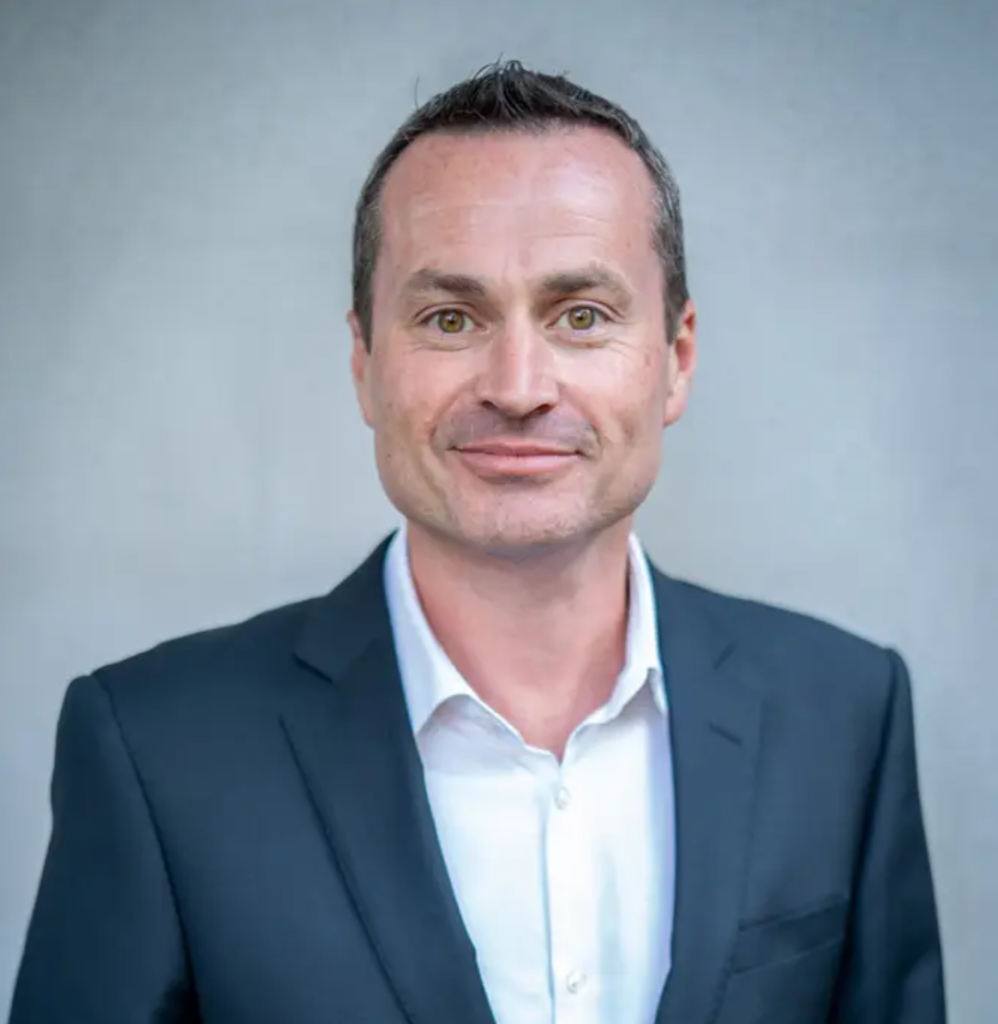
 Michael Kewley, one of our respected alumni, left the school over two decades ago. Since then, he has established a successful career as an experienced marketing and communications professional in multiple sectors including FMCG, electrical appliances and education, and has recently co-founded his own boutique marketing agency in Switzerland called Magnetic Communications.
Bournemouth School is a family affair for him; with multiple generations having completed their education here, including his father, uncle, brothers and nephew. During his time at the school, Michael studied Latin, French and English at A Level, General Studies at AS Level, English at S Level and he also completed an AS in Christian Theology alongside his GCSE examinations. Michael felt that his time at the school was a period when he had “the legitimacy to just be a bit geeky”. He also feels that the school “really opened my horizons in terms of what education could be about”. This is evidenced by his continuation to Magdalen College, Oxford, to study languages, an opportunity that he feels was enabled by support from the school and proved to be a “transformative experience”.
Michael attended Bournemouth School between 1987 and 1994 and names a number of teachers as having had an impact on his time as a student. Mr Tony Jordan was one such name, as he generously gave his time after school hours to tutor Michael and another student privately. Sadly, Mr Jordan has since passed away.
Other teachers of note for Michael were Mr David Spencer, a Latin teacher at the time, and Mrs Laura Fisher, his form tutor for years 10 and 11, whom he fondly referred to as his “second mum”. Michael recalls spending break time and occasional lunchtimes sharing toast and tea with her. Michael goes on to mention what he colloquially refers to as “the Holy Trinity” of teachers, which included Mr Spencer, Mr Paul Beardshaw and the late Mr John Hawkins (often affectionally known as “Happy Harry”!). Mr Nick McCabe also deserves a mention as, although he had already retired as a Bournemouth School teacher, he offered to tutor Michael for the Oxford Entrance Exams, despite never having actually taught him.
Whilst a student, Michael played snare drum in the Combined Cadet Force band. He was also a member of a four-piece rock band with the famed British choirmaster and Bournemouth School alumnus Gareth Malone. Michael’s love of music has continued throughout his life and he names listening to music as one of his enjoyable hobbies, along with sampling the infamous French wines near to where he lives, and cooking as a form of relaxation.
After graduating from Oxford University, Michael secured a position at Procter and Gamble (relocating to Switzerland) and remained with them for seventeen years before moving into educational marketing in 2015. From here, starting up his company with his partner came from his own unique experience in education; the feeling that “everything lined up” led to the opportunity to blend the two worlds of academia and marketing.
His company, Magnetic Communications, a marketing and communications organisation for the education sector, focuses mostly on “step-changing” school performance by offering advice and recommendations that can have “a transformational impact. Not just minor incremental changes, but really challenging what people are doing,” with an aim for his clients to be provided with the tools and processes to “set them off on a totally new path which leads them to greater success”.
When asked what attributes he feels are advantageous when working with such a wide scope of business sectors, Michael believes that it comes down to two concepts. “One is applying the principles of marketing. It doesn’t matter if you’re marketing a school or an electric razor or soap powder; there’s a standard framework that’s been proven to work for decades and decades. And if you apply that framework to any business, then you can improve how things work. And the second thing I’d say is curiosity”.
This led onto what Michael felt were the key attributes that contribute to a great team leader, with Michael believing that the most important thing is “listening to other people” and “being able to set a clear direction… sincerely listening to other people’s answers to make sure that you get all of the brain power and the expertise to inform a decision”. This collective thinking stems from a previous manager of Michael’s who used to say “all of us are much smarter than one of us”.
The conversation steered towards the impact of AI in business, with Michael acknowledging that his initial scepticism has evolved slightly. He appreciates the usefulness of AI and recognises the time-saving capabilities, but also the potential to replace jobs, especially in fields such as coding, and shared his concerns that AI has the potential to affect how humans think, stating, “Sadly, a bit like mobile phones, many young people will end up relying entirely on AI and physiologically their brains will simply not develop in the way that they should”. However, Michael feels that there are certain subject areas where human interaction and interpretation will remain desirable, stating that, “If you learn humanities – not just languages, but literature, history and humanities more broadly – you get an understanding of human beings and I think what will differentiate successful people in the future is those who can actually form productive human relationships”.
Michael spent sixteen years as a volunteer fire and rescue officer, explaining that France relies on volunteers, with 90% of the country’s fire service being non-professional. They also act in the capacity of paramedics in the role, too. He feels this has had a huge effect on his language skills as by acting as a first responder, where you are confronted by “somebody who’s desperately ill or had an accident, or whose house is burning down, your language skills improve pretty quickly”. Michael was also involved in his town council for over a decade, highlighting his philanthropic nature and keenness to become part of his community. This was exemplified by him obtaining French nationality so that he could act as First Deputy to the Mayor, for which being a French citizen is a requirement.
This resilience is something he believes is not necessarily channelling down into the younger generations, with young people today “largely driven by screen addiction”, but if he were to offer some strategies for them with stressful periods or times of exams, he thinks that “actually sitting down and revising and reading stuff and doing the work is still the most successful way to get through exams,” believing that “hard work generally pays out”.